
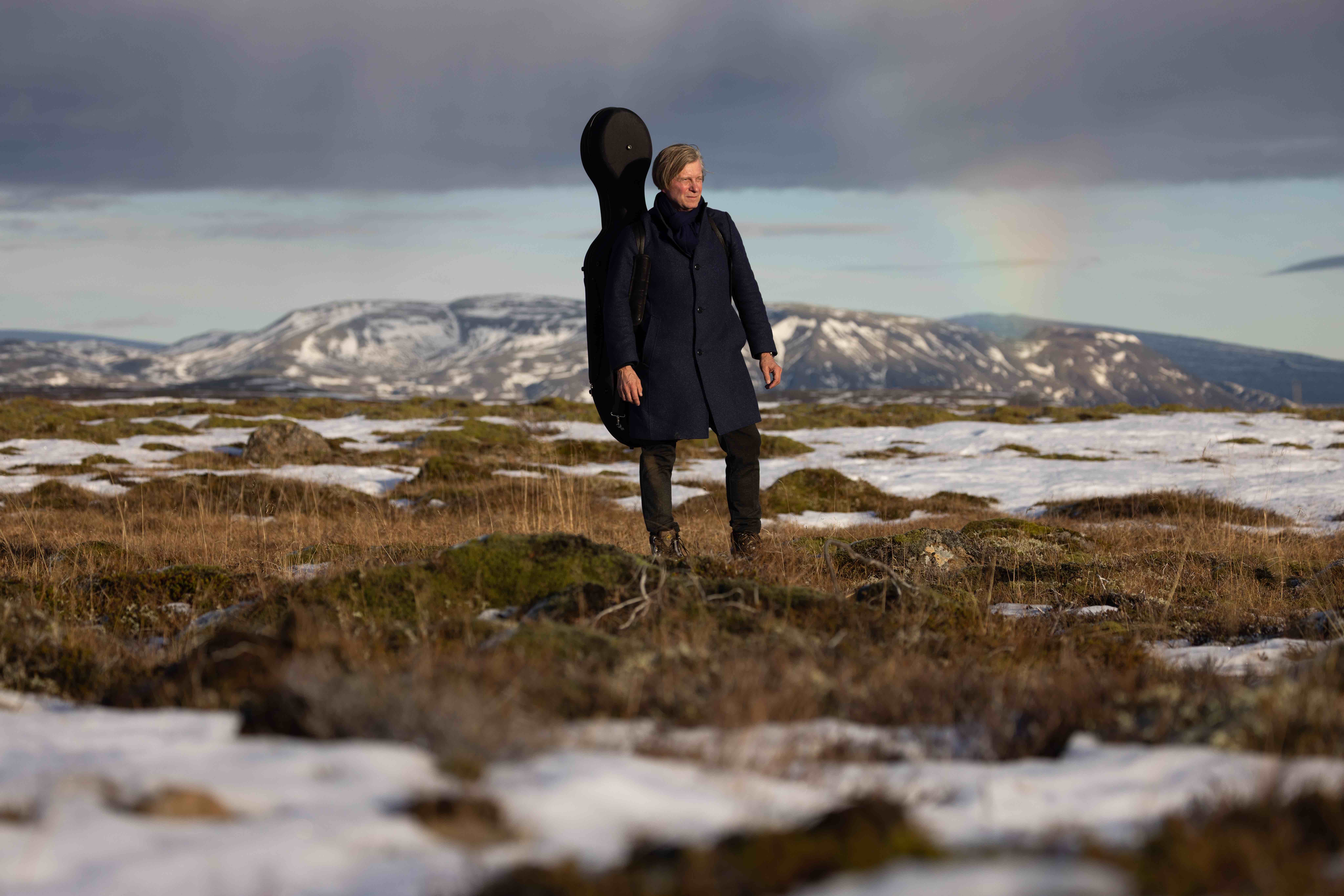

Icelandic composer and cellist Eythor Arnalds continues to blur the boundaries between contemporary classical composition, cinematic ambience, and mindful listening on his expansive new ten-track album ‘Music for Walking’, released via Alda Music. Built as both a musical journey and a meditation on movement, the record unfolds as a soundtrack for walking, not simply through landscapes, but through thought, memory, and emotional progression itself.
Known for creating immersive instrumental works rooted in stillness and reflection, Arnalds draws from the lineage of artists such as Max Richter, Ólafur Arnalds, Brian Eno, Nils Frahm, and Hildur Guðnadóttir, while shaping a voice distinctly his own. Recorded with the Reykjavík Symphony Orchestra at Harpa Concert Hall and produced alongside Grammy-nominated engineer Bergur Þórisson, Music for Walking transforms ambient string music into something deeply physical, music designed to move with the listener, step by step.
At the heart of the album sits the focus single “Progression,” accompanied by a striking new visual directed by filmmaker and explorer Karim Iliya. The piece evolves slowly around four delicate broken chords as violin lines drift above softly pulsing harp and piano ostinatos, while Arnalds’ cello gradually rises through the arrangement like a quiet internal awakening. The result is meditative, cinematic, and emotionally weightless, a composition less concerned with destination than the act of becoming.
“Life is a progression. It is a mental journey,” Arnalds explains. “In many ways walking is symbolic of our life. The walking may have a destination, but it has meaning in itself. The experience of walking makes our thoughts progress, like seeds into a plant. A progression in a state of no words, listening to music is a form of meditation which I like to do with my headphones, preferably on a mountain in Iceland. The album Music for Walking is made for such experiences. No words, pure music and walking. In the current age of sensational news and polarisation, it should be a break from that noise and bring waves of tranquility and calm.”
Throughout Music for Walking, Arnalds treats repetition, breath, and motion as compositional tools. Tracks like “Body of Water,” “Opening,” and “Promenade No. 7” unfold gradually, mirroring the rhythms of footsteps and shifting landscapes. Rather than demanding attention through dramatic crescendos, the album rewards immersion, inviting listeners into a slower and more reflective state of consciousness.
The visual world surrounding the project expands this sense of movement and atmosphere even further. Shot across Iceland’s stark southern landscapes, the “Progression” video pairs Arnalds’ music with sweeping footage of glaciers, drifting icebergs, volcanic terrain, and shifting Arctic skies. Iliya’s filmmaking captures nature not as backdrop but as participant, a living reflection of the album’s themes of flow, fragility, and transformation.
“Arctic landscapes can be harsh but beautiful,” says Iliya. “Even in a world locked in ice, there is movement as clouds drape the mountain sides, glaciers carve their way through mountains, and icebergs drift through the blue. As the ice melts, and the sun returns, Eythor moves through the arctic landscape with his cello, playing to the ice, the birds, the mountains and the rivers.”
Deeply rooted in Icelandic nature and modern minimalist composition, Music for Walking positions Eythor Arnalds as a composer creating music not simply to be heard, but experienced physically and emotionally. In an increasingly overstimulated world, the album offers something increasingly rare: space to breathe, think, and move slowly again.
Follow Eythor Arnalds on: Instagram / TikTok

Leave A Reply